_edited_edited_.png)
How Does a Roth IRA Grow?

A Roth IRA grows through a combination of consistent contributions, investment returns, and compound interest working together over time. By allocating capital to assets such as stocks, bonds, and mutual funds, you generate growth through price appreciation and dividends. Reinvesting these earnings initiates a compounding cycle where your returns generate their own gains, accelerating your balance over time.
Multiple factors determine the speed of this growth, including the time horizon, asset allocation, market performance, and the consistency of contributions. To optimize your account, leverage the Roth IRA’s unique tax structure. Since qualified withdrawals are tax-free and there are no required minimum distributions (RMDs), your funds can remain invested indefinitely during your lifetime. Focus on a long-term horizon and disciplined contribution habits to confirm that your asset allocation effectively drives long-term financial results.
Through Contributions
Regularly funding a Roth IRA is the most effective way to fuel long-term wealth. Funds contributed earlier have more time to move through cycles of growth and reinvestment, leading to a larger balance. Prioritizing annual contributions fosters steady expansion rather than relying on market fluctuations, as even modest, frequent deposits add vital layers to the compounding process.
Maintaining a disciplined funding pattern strengthens your long-term outcomes, creating a reliable flow of capital that helps your portfolio flourish across various market cycles. By committing to these regular additions, you establish a robust financial foundation for your retirement goals. Ultimately, contribution limits define the maximum amount allowed each year, directly shaping overall growth potential.
Roth IRA Contribution Limits
The Roth IRA contribution limit for the 2026 tax year allows individuals to contribute up to $7,500, while those age 50 or older can contribute up to $8,600 through catch-up contributions. Eligibility to contribute to a Roth IRA depends on income. For single filers, contributions begin to phase out at $168,000, while for those filing jointly, the phase-out starts at $252,000.
Staying within these limits and contributing the full allowed amount when possible gives your portfolio more capital to compound over decades. Higher limits for individuals age 50 or older (catch-up contributions) provide an opportunity to accelerate Roth IRA growth later in life. Income thresholds may affect eligibility, so understanding these boundaries helps you plan contributions efficiently and avoid missed opportunities.
Through Investment Returns
Growing a Roth IRA beyond its initial contributions requires investing in productive assets such as stocks or equity-focused funds. Reinvesting these returns into the existing balance enables the account to grow significantly over time, with asset selection dictating the pace of growth. Prioritizing investments with high growth potential, such as stocks or equity-focused funds, results in stronger long-term returns than conservative options like bonds or cash.
To make sure steady progress, structure a portfolio that balances growth and risk based on a specific time horizon and risk tolerance. This strategic approach helps your account flourish as you navigate market fluctuations, ensuring your retirement savings continue to build momentum over the coming decades.
Types of investments in a Roth IRA
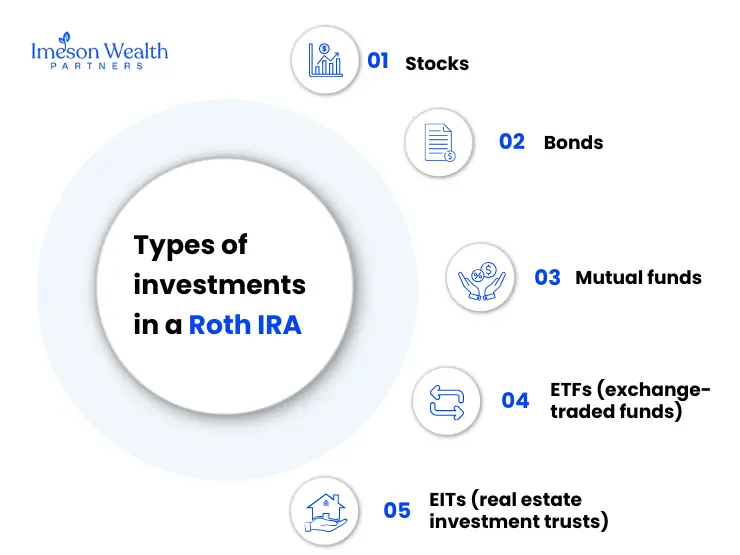
A Roth IRA holds a range of investment options, each with different growth potential and risk levels:
Stocks: Acquire equity in individual corporations to drive long-term capital appreciation. While stocks offer the highest historical growth potential, they are subject to short-term market volatility.
Bonds: Utilize these fixed-income debt instruments to reduce regular interest payments. Bonds provide a stabilizing effect on a portfolio, offering lower volatility than equities.
Mutual funds: Participate in professionally managed pools of capital that provide instant exposure to a diversified basket of securities, such as stocks or bonds.
ETFs (exchange-traded funds): Invest in funds that track specific indexes or sectors. These trade on open exchanges like individual stocks, providing broad diversification with typically lower overhead costs.
REITs (real estate investment trusts): Gain exposure to large-scale, income-producing real estate. These trusts generate returns through property appreciation and rental income without the need to manage physical assets.
Each type of Roth IRA carries a different risk-return profile. Stocks tend to offer higher returns with more volatility, while bonds provide stability with lower returns. Funds and ETFs blend multiple assets, reducing exposure to any single investment. Diversification across these assets spreads risk and creates a more balanced portfolio. By combining growth-oriented and stable investments, a Roth IRA account is better positioned to grow over time while handling market fluctuations.
Role of dividends and capital gains
Dividends and capital gains serve as the primary sources of returns in a Roth IRA. Reinvesting dividends and capital gains within a Roth IRA accelerates the compounding process. Instead of withdrawing these returns, using dividends to purchase additional shares increases the total balance and generates further earnings. Simultaneously, keeping capital gains invested allows the portfolio to expand as asset values rise, seeking to maximize the tax-free growth potential unique to a Roth IRA.
Within the specific structure of a Roth IRA, both dividends and capital gains grow tax-free. Furthermore, all qualified withdrawals are tax-exempt. This unique advantage verify the full amount of your earnings stays invested to compound over the long term, significantly strengthening overall growth.
Through Compound Interest
You can grow your Roth IRA by tapping into compound interest, the process by which earnings generate additional earnings over time. To do this effectively, make sure that all investment returns, such as dividends and capital gains, are automatically reinvested. This allows your Roth IRA account to grow based on both your original contributions and the profit you have already made. This creates a compounding cycle where each layer of growth builds on the previous one. As time passes, the growth rate accelerates because the base amount continues to expand. Reinvesting all earnings instead of withdrawing returns allows the full balance to continue compounding, driving substantial long-term growth.
Compound interest in a Roth IRA
Increase your Roth IRA’s growth by leveraging compound interest, the process where your earnings start generating their own returns. To do this effectively, make sure that all investment income, including dividends, interest, and capital gains, is reinvested in the account. This strategy allows your balance to build on both your original contributions and your past gains simultaneously. Over time, this creates a powerful snowball effect for your retirement savings. Your account balance grows not just from your yearly contributions, but from an ever-expanding base of accumulated earnings. By keeping these funds invested, you accelerate growth and allow compounding to reach its full potential over the long term.
Reinvest earnings to boost growth
Roth IRAs grow by ensuring all dividends, interest, and capital gains remain inside the account to purchase additional shares rather than sitting idle. This process strengthens compounding because every reinvested dollar expands your total invested balance, allowing you to generate returns on both your original contributions and an ever-growing pool of accumulated gains. To maintain consistency, enable automatic reinvestment through dividend reinvestment plans (DRIPs), which removes the need for manual action and keeps your money fully productive. By keeping these earnings invested within the tax-free environment of a Roth IRA, you eliminate tax drag and allow the account to grow at a significantly faster pace over the long term.
The Rule of 72
The Rule of 72 provides a practical way to estimate how long it takes for your Roth IRA to double based on its rate of return. Divide 72 by the expected annual return to estimate the time required for an investment to double, illustrating the mechanical power of compounding over time. For example, an average annual return of 8% would double your account balance in about 9 years (72/8). This calculation highlights the critical roles of consistent returns and time, as higher rates of return significantly shorten the doubling period, while even small differences in performance can lead to massive changes in total growth over long durations.
How Much Does a Roth IRA Grow in 20 Years?
With a $7,500 annual contribution, a Roth IRA can grow to approximately $315,000 over 20 years, assuming a steady 7% average annual return. The final balance depends on the specific rate of return and the effect of compounding over time:
At 5% average return: about $250,000
At 7% average return: about $310,000–$320,000
At 10% average return: about $430,000–$470,000
These estimates assume consistent yearly contributions and that all earnings remain invested. Over 20 years, a larger portion of the final balance comes from accumulated returns rather than from contributions alone, showing how compounding builds momentum over time.
What Determines How Fast Your Roth IRA Grows?

Factors determining IRA growth include time horizon, asset allocation, market performance, investment strategy, and contribution consistency. These elements dictate how much capital enters the account and how efficiently that money compounds. Aligning these factors leads to more consistent and accelerated portfolio growth over the long term.
Time Horizon
Prioritize a long time horizon by contributing as early as possible. This gives your investments more time to compound across multiple reinvestment cycles, significantly boosting your final balance over several decades.
Asset Allocation
Structure your asset allocation to balance growth-oriented investments with more stable options. While a higher allocation to stocks can lead to stronger returns, a diversified mix helps maintain steady compounding across varying market conditions.
Market performance and Volatility
Maintain your position through market cycles to manage short-term volatility. Staying invested confirms that compounding continues uninterrupted, which is essential for recovering losses and capturing long-term gains.
Investment Strategy and Risk Tolerance
Align your investment strategy with your personal risk tolerance to establish long-term consistency. A stable approach during market changes prevents emotional decisions that could disrupt compounding or slow your overall progress.
Contribution Consistency and Frequency
Commit to regular contributions to steadily increase your invested base. This frequent flow of capital creates multiple entry points into the market and provides new funds that can immediately begin generating additional returns.
Does a Roth IRA Grow Tax-Free?
Yes, a Roth IRA grows tax-free because contributions are made with after-tax dollars. This structure provides a distinct advantage over Traditional IRAs or 401(k)s, which function as tax-deferred accounts. In those traditional plans, an immediate tax break applies to contributions, but income tax applies to both the principal and the growth during retirement.
With a Roth IRA, paying taxes on the "seed" today confirms the entire "harvest" remains tax-free later. Provided the five-year rule is met, and the owner reaches age 59½, all growth and contributions become available for withdrawal without tax liability. This locks in current tax rates and eliminates future taxes on all accumulated earnings.
After-Tax Contributions
Fund your account with after-tax dollars to establish a flexible tax-free foundation. Since the government has already taxed this capital, you can withdraw your original contributions at any time and for any reason without facing new taxes or penalties. This strategic approach to tax planning allows your principal to serve as a secondary emergency resource while the earnings remain locked away to grow.
Qualified Withdrawals and the Five-Year Rule
To make sure your earnings remain entirely tax-exempt, wait until you are at least 59½ years old and confirm your account has been open for at least five tax years. Meeting these two requirements converts your investment gains into "qualified" distributions. Accessing earnings before satisfying this five-year timeline or the age requirement may trigger unnecessary taxes and penalties on your growth.
Tax Treatment of Dividends, Interest, and Capital Gains
Leverage the Roth IRA environment to eliminate all internal investment activity from annual taxation. Unlike a standard brokerage account, where dividends and capital gains are taxed yearly, a Roth IRA eliminates "tax drag," allowing every cent of interest and profit to stay in the account. Reinvesting these full amounts back into the market accelerates the compounding process and builds wealth much faster over the long term.
How Avoiding Required Minimum Distributions (RMDs) Helps Your Roth IRA Grow?
Avoiding Required Minimum Distributions (RMDs) allows a Roth IRA to keep the entire balance invested, which supports continued compounding over a longer period. Since no withdrawals are required during the account holder’s lifetime, funds remain in the market and continue generating returns. RMDs in other retirement accounts reduce the invested balance over time, which limits how much can compound. In contrast, a Roth IRA maintains a larger base, allowing earnings to build without interruption.
You can leave the account untouched, allow it to grow further, or use it strategically for income planning. It can support wealth transfer as well, since beneficiaries may receive assets that have continued growing without forced distributions during the original owner’s lifetime.
Does a Roth IRA Grow After Retirement?
Yes, a Roth IRA continues to grow after retirement as long as the funds remain invested. With no Required Minimum Distributions (RMDs) during the account holder’s lifetime, the entire balance can remain invested and continue to compound. Earnings remain tax-free under qualified conditions, allowing all gains to stay within the account without being reduced by taxes. This supports ongoing growth even after you stop working and begin drawing income from other sources, making it a critical component of long-term retirement planning.
Flexible account setups allow for delayed withdrawals and extended compounding periods, effectively positioning assets for growth within an estate plan to benefit future heirs.
How Roth IRA Growth Compares to Other Retirement Accounts?
A Roth IRA offers the same investment opportunities as other retirement accounts, but its tax structure changes how growth is realized over time. With a Roth IRA, earnings grow and can be withdrawn tax-free under qualified rules, allowing compounding to continue without future tax. Traditional IRAs and 401(k)s grow tax-deferred, but withdrawals are taxed as income, which can reduce net returns. Taxable brokerage accounts are subject to taxes on dividends and capital gains, which can slow compounding. In contrast, a Roth IRA allows the full value of returns to remain invested, supporting stronger long-term growth.
Roth IRA vs Traditional IRA
A Roth IRA provides tax-free withdrawals in retirement by using after-tax contributions, whereas a Traditional IRA offers an immediate tax deduction but taxes future distributions. While Roth IRAs have no lifetime RMDs, Traditional IRAs mandate withdrawals starting at age 73.
Feature | Roth IRA | Traditional IRA |
Contributions | After-tax dollars | Pre-tax or tax-deductible |
Growth | Tax-free | Tax-deferred |
Withdrawals | Tax-free (qualified) | Taxed as income |
RMDs | None during lifetime | Required at a certain age |
Best Use | Long-term tax-free growth | Immediate tax deduction |
Roth IRA vs 401(k)
A Roth IRA is an individual account with a wide range of investment options, whereas a 401(k) is an employer-sponsored plan that often includes a company match. While 401(k)s allow much higher annual contributions, Roth IRAs offer more flexible access to your original principal.
Feature | Roth IRA | 401(k) |
Contributions | After-tax | Often pre-tax (Roth 401(k) option may exist) |
Growth | Tax-free | Tax-deferred or tax-free (Roth 401(k)) |
Investment Options | Broad (self-directed) | Limited to plan offerings |
RMDs | None during lifetime | Required (varies by type) |
Control | Individual control | Employer-sponsored plan |
Roth IRA vs Taxable Brokerage Account
A Roth IRA shields all investment growth from taxes indefinitely, whereas a taxable brokerage account incurs taxes on capital gains and dividends annually. While brokerage accounts have no contribution limits, they lack the tax-free compounding benefits of a Roth IRA.
Feature | Roth IRA | Taxable Brokerage Account |
Contributions | After-tax with limits | No limits |
Growth | Tax-free (qualified) | Taxed annually or on gains |
Withdrawals | Tax-free (qualified) | Capital gains tax may apply |
Flexibility | Rules for withdrawals | Full access anytime |
Long-Term Growth | Strong due to no tax drag | Reduced by ongoing taxes |
How to Boost Your Roth IRA Growth?
Increase Roth IRA growth by starting early, choosing the right investments, making annual contributions, reinvesting earnings, diversifying assets, and using a backdoor Roth IRA if necessary. These actions build your balance and strengthen compounding over time. Regular deposits in growth-oriented assets confirm steady expansion, even during market shifts. To align this strategy with your risk tolerance, consult a CERTIFIED FINANCIAL PLANNER® for long-term success.
Start Early and Contribute Consistently
Begin your retirement savings as soon as possible to give your capital the maximum time to grow. Start a Roth IRA between the ages of 18 and 25 to amplify long-term returns. Establishing a regular contribution schedule helps you build a substantial nest egg through the power of time market participation and effective cash flow management.
Choose the Right Investments for Long-Term Growth
Select a strategic mix of equities and growth-oriented assets that align with your risk tolerance and timeline. Focus on high-quality holdings that have the potential to outpace inflation and deliver significant returns over several decades.
Increase Your Annual Contributions Every Year
Aim to reach the full contribution limit allowed by the IRS for your retirement accounts annually. Consistently hitting these benchmarks allows you to take full advantage of tax-advantaged growth and increases your total wealth at retirement.
Reinvest All Dividends to Accelerate Compounding
Direct all dividend payments back into your portfolio to automatically purchase additional shares. This process creates a powerful compounding effect, where your earnings begin to generate their own returns, significantly boosting your account balance.
Diversify Across Asset Classes
Spread your capital across various sectors, such as stocks, bonds, and real estate, to mitigate risk. A well-diversified portfolio shields you from significant losses in any single market area while providing multiple avenues for steady gains and robust risk management.
Consider the Backdoor Roth IRA If You Exceed Income Limits
Explore the backdoor strategy to gain tax-free growth if your earnings surpass the standard eligibility thresholds for a Roth IRA. This maneuver involves contributing to a traditional IRA and then converting it, allowing high earners to still access Roth benefits.
Disclosures:
This material is provided for educational purposes only and does not constitute a recommendation or individualized investment or tax advice. There is no guarantee that the views or strategies discussed are suitable for all investors or will achieve desired results. Investors should consult a qualified financial and tax professional to determine what is appropriate for their individual situation. All illustrations are hypothetical examples and are not representative of any specific situation.
Traditional IRA and 401(k) contributions may be tax deductible in the contribution year, with current income tax due at withdrawal. Withdrawals prior to age 59½ may result in a 10% IRS penalty tax in addition to current income tax.
Roth IRA and Roth 401(k) accounts offer tax free withdrawals when distributions are qualified, with tax deferred growth on earnings. Withdrawals of earnings prior to age 59½ or before the account has been open for 5 years, whichever is later, may result in a 10% IRS penalty tax. Limitations and restrictions may apply.
Traditional IRA owners should carefully consider several factors before performing a Roth IRA conversion, including the income tax consequences on the amount converted in the year of conversion, Roth IRA withdrawal limitations, and income limitations on future Roth IRA contributions. If a required minimum distribution (RMD) is applicable in the year of conversion, the RMD must be taken prior to converting assets to a Roth IRA.
Brokerage account investments are taxable in the year dividends, interest, or capital gains are realized. Withdrawals may be made at any time and are not subject to IRS early withdrawal penalties, though applicable taxes may apply based on the type of income or gain realized.


Comments