_edited_edited_.png)
10 Retirement Planning Strategies for Women

Updated: 1 day ago
Career breaks, caregiving responsibilities, changing earnings, and longer retirement periods can affect how women accumulate savings and generate retirement income. A structured approach includes choosing the right retirement plans and accounts, capturing the full employer match, using catch-up contributions after age 50, and funding a spousal IRA during eligible career breaks. These strategies help women maintain retirement contributions across different employment, income, and family circumstances while building assets for future expenses.
Retirement planning should also address healthcare costs through an HSA when eligible, Social Security timing, and investments designed for long-term growth. Women can connect these strategies with a retirement budget, debt management, emergency reserves, and income from pensions, retirement accounts, taxable investments, and other available sources. Tax-aware withdrawal decisions can further coordinate taxable, tax-deferred, and Roth assets during retirement. Regularly review contributions, account balances, investment allocation, healthcare expenses, expected income, and retirement dates to keep the plan responsive to career changes, family responsibilities, marital changes, and evolving financial needs throughout working years and retirement.
10 Retirement Planning Strategies for Women are:

Choose the Right Retirement Plans and Accounts
Women should select retirement accounts based on employment status, income, tax treatment, contribution capacity, and retirement goals. Workplace options include 401(k), 403(b), and 457(b) plans, while Traditional IRAs and Roth IRAs provide individual retirement savings options. Self-employed women and business owners may also use SEP IRAs, SIMPLE IRAs, or Solo 401(k) plans depending on their business and employee structure.
2026 Contribution Limits:
Retirement Account | 2026 Contribution Limit |
401(k) / 403(b) / 457(b) | Generally, the lesser of $24,500 or applicable compensation |
Traditional & Roth IRAs | $7,500 standard limit |
SEP IRA | Up to 25% of eligible compensation or $72,000, whichever is less |
SIMPLE IRA | Generally $17,000, although higher limits can apply to certain SIMPLE plans |
Solo 401(k) | $24,500 employee deferral limit, with combined contributions up to $72,000 before eligible catch-up contributions |
Capture the Full Employer Match
Employer matching contributions can increase the amount directed toward a woman's account without requiring her to contribute the full amount from personal earnings. This matters for women whose contribution histories may include maternity leave, caregiving periods, part-time employment, or other workforce interruptions. A workplace plan may require a specific employee contribution percentage before the employer provides its full available match.
Review the Summary Plan Description to identify the matching formula, required employee contribution, vesting schedule, and any year-end true-up provision. Set payroll contributions to receive the available employer match when personal cash flow permits. If matching occurs each pay period, review how contribution timing affects employer deposits throughout the year. Before changing jobs or taking a career break, check the vesting schedule to determine how much of the employer-funded account balance you currently own.
Use Catch-Up Contributions After Age 50
Catch-up contributions allow women age 50 and older to add extra money to eligible retirement accounts beyond standard annual limits. These contributions can matter after years of reduced earnings, caregiving, part-time work, or career interruptions. Women who have more available income later in their careers can use these higher limits to direct additional earnings toward savings.
IRS 2026 Catch-Up Limits:
401(k), 403(b), 457(b): Extra $8,000 for ages 50+. Participants ages 60–63 qualify for an $11,250 catch-up.
IRAs: Extra $1,100 above the $7,500 standard limit for ages 50+.
SIMPLE IRA: Extra $4,000 at age 50+, or $5,250 for participants ages 60–63.
Use a Spousal IRA During Career Breaks
Women who leave paid employment for childcare, eldercare, family responsibilities, or other unpaid periods may lose access to workplace retirement contributions. A spousal IRA can allow an eligible married couple filing a joint federal income tax return to continue funding an IRA for a spouse with little or no taxable compensation, provided the couple has sufficient eligible compensation and meets applicable IRS requirements. This approach keeps retirement contributions active during qualifying workforce gaps rather than tying retirement savings entirely to current employment.
A spousal IRA is not a jointly owned account; it belongs individually to the spouse whose name and Social Security number are attached to it. Standard IRA contribution limits apply ($7,500 standard, or $8,600 for age 50+). Income, tax-filing status, compensation, and workplace plan coverage can affect eligibility or deductibility, so review these factors before funding.
Plan Healthcare Costs With an HSA
A Health Savings Account (HSA) can cover qualified medical expenses while preserving other savings for everyday living costs. For women, this helps when planning for longer retirement horizons and potential healthcare spending needs. Enrolling in an eligible high-deductible health plan lets contributions receive favorable tax treatment, keeps growth tax-free under applicable rules, and lets withdrawals for qualified medical expenses stay tax-free. Qualified expenses include prescriptions, deductibles, dental care, and vision care.
As retirement approaches, factor the transition to Medicare into your HSA strategy. New contributions stop after Medicare enrollment, but you can still use existing HSA funds for eligible medical costs. Estimate expected healthcare expenses alongside housing, food, and insurance, then map out how your HSA works alongside Social Security, pensions, and savings over time.
Time Social Security Benefits Carefully
Social Security claiming age can change the monthly retirement benefit a woman receives. Retirement benefits can generally begin at age 62, but claiming before full retirement age results in a permanently reduced monthly benefit. Full retirement age ranges from 66 to 67 based on birth year. Delaying eligible retirement benefits beyond full retirement age can increase the monthly payment through delayed retirement credits until age 70.
Women should evaluate their expected retirement date, employment income, life expectancy, healthcare expenses, pensions, and retirement-account withdrawals before choosing a claiming age. Spousal, survivor, and divorced-spouse benefits may also affect the decision. A divorced person whose marriage lasted at least 10 years may qualify for benefits using a former spouse's earnings record when Social Security requirements are met. Coordinating these benefits with other retirement income sources provides a clearer view of expected retirement cash flow.
Invest for Long-Term Growth
Women should structure retirement investments around the number of years remaining before retirement and the period during which retirement assets may need to produce income. A diversified portfolio can distribute assets among investments such as stocks and bonds based on retirement timeline, income requirements, and tolerance for market fluctuations. This allocation can change as a woman moves from accumulation years toward retirement income withdrawals.
Inflation also matters because rising prices reduce money's future purchasing power. Holding too much in cash may limit market exposure, but cash can lose purchasing power as living expenses rise. Women should periodically review investment allocation after changes in income, retirement date, spending expectations, or financial circumstances. Diversification can spread investment exposure across asset classes, but it does not eliminate market losses. Investment decisions should therefore remain connected to retirement income requirements rather than short-term market movements.
Create a Retirement Budget and Spending Plan
Longer life expectancies, career interruptions, caregiving responsibilities, and changes in lifetime earnings can affect how much retirement income women need to generate from assets. A retirement budget connects these circumstances with projected housing, healthcare, insurance, food, taxes, travel, and caregiving expenses. Women can use these estimates to define expected spending and understand how circumstances may influence income needs throughout retirement.
Women should map income from Social Security, pensions, workplace plans, IRAs, taxable accounts, annuities, and survivor benefits. Comparing projected expenses with expected income reveals any retirement income gap that savings and investments must fill. They should also determine how taxable, tax-deferred, and Roth accounts will fund spending while accounting for tax liabilities and required minimum distributions. Regular reviews can keep income sources, withdrawals, and spending aligned as financial circumstances change.
Reduce Debt and Protect Retirement Assets
Career breaks, reduced working hours, divorce, widowhood, and caregiving responsibilities can leave women approaching retirement with different debt levels and accumulated assets than originally projected. Managing mortgages, credit cards, personal loans, and other obligations before retirement can reduce recurring payments that compete with housing, healthcare, and everyday living expenses. Women should review each debt by balance, interest rate, monthly payment, and remaining term to understand its effect on expected retirement income.
Longer retirement periods can also increase exposure to medical expenses, long-term care costs, and unexpected household costs. Maintaining accessible emergency reserves can reduce the need to withdraw immediately from retirement accounts for unplanned expenses. Women should review insurance coverage, beneficiary designations, account ownership, and estate documents after marriage, divorce, widowhood, inheritance, or family changes to keep retirement assets aligned with income needs and intended beneficiaries.
Stay Involved in Financial Decisions
Women should stay involved in decisions about household finances, retirement accounts, investments, taxes, insurance policies, beneficiaries, and withdrawals. Regular reviews help identify changes in contribution rates, investment allocations, advisory fees, expense ratios, administration costs, and beneficiary information. Keep financial records organized so you can easily locate statements, pension information, Social Security estimates, and insurance policies.
Financial circumstances change after marriage, divorce, widowhood, caregiving responsibilities, job transitions, or health changes. Reassess retirement projections and account decisions after these events rather than relying on old assumptions. Discussing your situation with family members, tax professionals, or qualified financial advisors clarifies how Social Security, withdrawals, healthcare expenses, investments, and taxes interact.
What Retirement Plan Options Are Available for Women?
Retirement plan options for women include employer-sponsored plans such as 401(k), 403(b), and 457(b) plans, individual accounts such as Traditional and Roth IRAs, and options for self-employed women such as SEP IRAs, SIMPLE IRAs, and Solo 401(k)s. These accounts can address different stages of a woman's career, including full-time employment, part-time work, career breaks, and business ownership. The contribution figures below reflect 2026 limits. Eligibility depends on employment, compensation, income, business structure, and applicable tax rules, not gender.
The retirement plan options available for women include:
401(k) Retirement Plans
A 401(k) allows employed women to contribute through payroll deductions, while participating employers may provide matching contributions. For 2026, employee elective deferrals can reach $24,500. Eligible participants age 50 and older can contribute an $8,000 catch-up, while ages 60 through 63 can contribute $11,250. Traditional contributions generally receive tax-deferred treatment, while designated Roth contributions use after-tax dollars when the employer plan offers that contribution option.
403(b) Retirement Plans
A 403(b) serves women working for public schools, eligible 501(c)(3) organizations, churches, and certain other qualifying employers. Employees may defer up to $24,500 in 2026. Participants age 50 and older may contribute an additional $8,000, while those ages 60 through 63 may qualify for an $11,250 catch-up. If the plan permits, certain employees with at least 15 years of service with the same qualifying employer may also qualify for a special 403(b) catch-up of up to $3,000 annually, subject to a $15,000 lifetime limit and other IRS calculations.
457(b) Retirement Plans
A 457(b) provides deferred compensation opportunities for women working for eligible state and local governments and certain tax-exempt organizations. The 2026 basic annual deferral limit is generally the lesser of $24,500 or 100% of includible compensation. Participants in governmental 457(b) plans may qualify for an $8,000 age-50 catch-up, while those ages 60 through 63 may qualify for an $11,250 catch-up. Governmental and nongovernmental 457(b) plans may also permit a special catch-up during the three taxable years before the plan's normal retirement age, based on unused prior-year deferral capacity. Participants generally cannot combine this special 457(b) catch-up with the age-based catch-up in the same year.
Traditional IRA
A Traditional IRA gives women an individually owned retirement account that can remain in place through job changes, caregiving periods, and other career transitions. In 2026, women under age 50 may contribute up to $7,500 across their Traditional and Roth IRAs, subject to taxable compensation requirements. After turning 50, the additional $1,100 catch-up raises that amount to $8,600. A tax deduction may apply based on income, filing status, and workplace plan coverage, while distributions from deductible contributions and earnings are generally taxable in retirement.
Roth IRA
A Roth IRA uses after-tax contributions and provides qualified tax-free withdrawals, giving women another tax treatment to consider when planning retirement income. IRA rules set the 2026 contribution ceiling at $7,500, shared with Traditional IRA contributions. Women age 50 and older receive another $1,100 of contribution room, bringing their available IRA amount to $8,600. Direct Roth IRA eligibility depends on income and filing status, so contribution access can change as a woman’s earnings or household circumstances change.
SEP IRA
A SEP IRA gives self-employed women and small-business owners a business-funded way to build retirement assets. For employees, 2026 contributions generally cannot exceed the lesser of 25% of eligible compensation or $72,000. Self-employed women use a different calculation based on adjusted net earnings from self-employment to determine their contributions. SEP IRAs generally do not allow employee elective salary deferrals or age-based catch-up contributions, so their contribution structure differs from 401(k), SIMPLE IRA, and similar plans.
SIMPLE IRA
A SIMPLE IRA gives women working for qualifying small employers access to salary-reduction contributions along with required employer contributions. The general employee deferral limit is $17,000 in 2026, with a general age-50+ catch-up of $4,000. Certain applicable SIMPLE plans may instead allow an $18,100 regular contribution limit with a $3,850 catch-up for eligible participants age 50 and older. Participants ages 60 through 63 may qualify for a $5,250 catch-up. Employers generally contribute through matching or nonelective contributions.
Solo 401(k)
A Solo 401(k) allows self-employed women with no eligible employees other than a spouse to contribute in both employee and employer roles. The employee side permits $24,500 in elective deferrals for 2026, while total employer and employee contributions are limited to $72,000 before eligible catch-up amounts, subject to compensation rules. This structure can suit women whose business earnings vary over time because contribution capacity reflects both their employee deferral opportunity and the employer contribution generated through the business.
Retirement Plan Options for Women by Employment Type
Retirement plan options for self-employed women include Solo 401(k)s, SEP IRAs, SIMPLE IRAs, and Traditional or Roth IRAs, while women with both employment and self-employment income may combine workplace plans with eligible self-employed accounts. Women without employer-sponsored retirement plans may use Traditional or Roth IRAs, spousal IRAs when eligible, or self-employed plans when they have qualifying business income.
The following employment categories show how these retirement plan options apply to women:
Self-Employed Women
Self-employed women can choose among Solo 401(k), SEP IRA, SIMPLE IRA, and individual IRA options based on business structure and earnings. A Solo 401(k) fits businesses without eligible employees other than a spouse, while SEP and SIMPLE IRAs address different employer contribution structures. Traditional and Roth IRAs provide separate individual savings opportunities.
Women With Both Employment and Self-Employment Income
Women with W-2 and self-employment income may use an employer 401(k) or 403(b), a Solo 401(k), a SEP IRA, and a Traditional or Roth IRA. Workplace contributions may receive an employer match, while business income supports self-employed contributions. Employee deferrals across a workplace 401(k) and Solo 401(k) share the applicable annual employee limit.
Women Without Employer-Sponsored Retirement Plans
Women without an employer-sponsored retirement plan can contribute to a Traditional or Roth IRA when eligible. Married women filing jointly may also fund an IRA in their own name using combined spousal compensation rules. Women with self-employment income can consider Solo 401(k), SEP IRA, or SIMPLE IRA options as well.
Retirement Planning for Women by Life Stage
Retirement planning for women in their 30s and 40s centers on regular contributions, employer matching, IRAs, and long-term investing, while women in their 50s can use catch-up contributions and compare savings with projected income needs. Women nearing retirement can coordinate account withdrawals, taxes, healthcare costs, and retirement dates, while women in their 60s can manage pensions, retirement accounts, ongoing contributions, beneficiaries, and required distributions.
The following points outline retirement planning priorities for women at different life stages:
Women in Their 30s and 40s
Women in their 30s and 40s should prioritize regular contributions, employer matching, and long-term investing while using retirement accounts available through their employment or self-employment. They can contribute to a 401(k), 403(b), or 457(b), and eligible individuals can also use Traditional or Roth IRAs. Self-employed women can use qualifying self-employed retirement plans.
Women in Their 50s
Women in their 50s should compare current savings with projected retirement income needs and increase contributions when possible. Use eligible catch-up contributions and review 401(k), 403(b), 457(b), IRA, or self-employed plan options. Consolidate old accounts when appropriate, update retirement projections, and steadily adjust contributions as the planned retirement date approaches.
Women Nearing Retirement
Women nearing retirement should set a target retirement date and determine how pensions, 401(k)s, 403(b)s, 457(b)s, IRAs, taxable accounts, and other income will fund spending. Review withdrawal timing, taxes, healthcare costs, and account-access rules. Decide which accounts to use first and whether continued contributions still fit the overall retirement plan.
Women in Their 60s
Women in their 60s should coordinate pensions, retirement accounts, and ongoing contributions if they continue working. Review 401(k), 403(b), 457(b), Traditional IRA, Roth IRA, and taxable account balances alongside withdrawal needs. Check tax treatment, beneficiaries, and required minimum distributions where applicable, then adjust withdrawals as income and expenses change annually.
Retirement Planning for Women by Marital Status
Retirement plan options for single women center on individual accounts and income, while married women can coordinate personal and household retirement accounts, spousal IRA eligibility, and Social Security benefits. Divorced women may plan around individually owned and divided retirement assets, while widowed women may account for survivor benefits and inherited accounts. Women returning to work after a career break can restart contributions through workplace plans and IRAs.
Retirement planning considerations by marital and career status include:
Single Women
Single women build retirement plans around their own earnings, savings, workplace accounts, IRAs, Social Security benefits, pensions, and expected expenses. A 401(k) or 403(b) can provide workplace savings and employer contributions when available, while Traditional and Roth IRAs provide individually owned savings. Retirement projections can account for housing, healthcare, taxes, longevity, emergency reserves, and future income needs without assuming spousal support.
Married Women
Married women can coordinate personal retirement accounts with household income, workplace plans, pensions, and Social Security benefits while maintaining individual account ownership. Working women may contribute to a 401(k) or 403(b), while spousal IRA rules can allow IRA contributions for a spouse with little or no compensation when eligibility requirements are met. Beneficiary designations, retirement dates, household expenses, and potential spousal and survivor benefits also influence retirement income planning.
Divorced Women
Divorced women may need to rebuild retirement projections around individually owned accounts, assets received through divorce, pension rights, and eligible Social Security benefits based on a former spouse's record. Certain employer retirement benefits may require a Qualified Domestic Relations Order to divide them. Updated beneficiary designations, account ownership, debts, living expenses, and contributions to an IRA or workplace plan can then form the basis of an independent retirement plan.
Widowed Women
Widowed women often face a change in household income that requires reviewing Social Security survivor benefits, pension payments, inherited retirement accounts, and personal retirement benefits. Survivor benefits may begin as early as age 60 under applicable Social Security rules, and payment amounts depend on claiming age. Inherited IRAs and workplace accounts can also present different distribution choices, making tax treatment, withdrawal requirements, household expenses, and future income needs relevant to retirement decisions.
Women Returning to Work After a Career Break
Women returning to work after a career break can restart retirement saving through a new 401(k), 403(b), Traditional IRA, or Roth IRA when eligible. Reviewing previous workplace accounts and available employer contributions helps reconnect earlier savings with current retirement goals. For women age 50 and older, applicable catch-up contributions provide additional room to save and can help address savings gaps from years of reduced or no employment income.
What Should Women Consider Before Choosing a Retirement Plan?
Women should consider current income and savings, employment status and available benefits, contribution limits and tax treatment, retirement timeline and income goals, and healthcare and long-term care needs before choosing a retirement plan. These factors determine available account options, contribution capacity, potential tax treatment, expected retirement funding needs, and how workplace plans, IRAs, Social Security, pensions, HSAs, and other assets fit within the retirement plan.
Consider these factors when choosing a retirement plan:

Current Income and Retirement Savings Position
Earnings, accumulated assets, and available cash flow determine how much a woman can reasonably direct toward retirement each year. Reviewing workplace accounts, IRAs, taxable investments, and other savings reveals her current retirement position and identifies funding gaps. A woman with greater contribution capacity may use multiple eligible accounts, while limited cash flow may require prioritizing employer matching, regular contributions, emergency reserves, and other financial obligations before increasing retirement savings over time.
Employment Status and Available Retirement Benefits
Access to retirement accounts changes according to whether a woman works as an employee, operates a business, earns self-employment income, or combines multiple income sources. Employees may have access to 401 (k), 403 (b), or 457 (b) plans with employer contributions, while business owners may qualify for Solo 401(k), SEP IRA, or SIMPLE IRA arrangements. Reviewing workplace benefits and business structure helps identify available accounts and coordinate contributions across eligible plans effectively.
Contribution Limits and Tax Advantages
Tax treatment affects when retirement contributions receive tax benefits and when withdrawals create taxable income. Traditional accounts generally use pre-tax or potentially deductible contributions with taxable distributions, while Roth accounts use after-tax contributions and permit qualified tax-free withdrawals. Annual IRS contribution limits determine how much women can contribute to each eligible account, and income rules can affect Traditional IRA deductions or direct Roth IRA eligibility, making tax status relevant to account selection decisions.
Retirement Timeline and Income Goals
Expected retirement age and future spending needs determine the time available for contributions, investment growth, and withdrawal planning. Women planning retirement years in advance have a longer investment period, while those approaching retirement may focus more on projected income and account access. Comparing anticipated expenses with Social Security, pensions, retirement accounts, and other income sources helps identify potential funding gaps and set contribution targets before the planned retirement date.
Healthcare Costs and Long-Term Care Needs
Future medical expenses can affect both retirement spending and the amount women need to accumulate before leaving work. Planning can account for Medicare eligibility, premiums, out-of-pocket expenses, prescription costs, and potential long-term care needs. Women enrolled in qualifying high-deductible health plans may also use HSAs for eligible medical expenses. Estimating these costs alongside housing and living expenses provides a fuller picture of expected retirement income requirements over a longer retirement period.
How Can Women Maximize Retirement Savings and Income?
Women can increase retirement savings and income by capturing employer contributions, using catch-up contributions, funding a spousal IRA during eligible career breaks, planning healthcare expenses with an HSA, investing for long-term growth, coordinating multiple income sources, and making tax-aware withdrawal decisions. Together, these approaches connect accumulation with income planning while accounting for career patterns, taxes, healthcare expenses, investment management, and changing financial needs throughout retirement.
Capture Full Employer Matching Contributions
Contributing enough to receive the full available employer match adds employer-funded money to a woman’s retirement account without requiring an equal increase in personal savings beyond the plan formula. Women should review matching percentages, contribution thresholds, and vesting schedules before setting payroll contributions. Career changes also warrant checking vesting status because leaving an employer before completing the required period can affect ownership of some employer contributions.
Use Catch-Up Contributions After Age 50
Increasing retirement contributions after age 50 gives eligible women more room to contribute during later working years, which can help address savings gaps from caregiving, reduced work hours, or earlier career interruptions. Catch-up amounts vary by retirement plan and age under current rules. Women can review their available cash flow, plan limits, and remaining years before retirement when deciding how much additional income to direct toward retirement accounts.
Use a Spousal IRA During Career Breaks
Funding an IRA in the nonworking or lower-earning spouse’s name allows eligible married women to continue accumulating retirement assets during qualifying workforce gaps. This approach can be relevant during caregiving periods when personal compensation declines or stops. The account remains individually owned by the woman, while eligibility depends on joint tax filing, sufficient taxable compensation between spouses, annual IRA contribution rules, and applicable income requirements for the selected IRA type.
Plan Healthcare Costs With an HSA
Using an HSA while enrolled in an eligible high-deductible health plan allows women to set aside funds for qualified healthcare expenses while receiving applicable federal tax benefits. Unused balances remain in the account and can support future medical spending. Women approaching Medicare should review contribution eligibility before enrollment because HSA contributions generally stop once Medicare coverage begins, although existing HSA funds remain available for eligible qualified expenses.
Invest for Long-Term Growth
Maintaining a diversified investment portfolio can help women pursue long-term growth while managing exposure across different asset classes and retirement periods. Asset allocation can reflect retirement timing, income needs, risk capacity, and other financial resources rather than relying on one universal investment mix. Regular portfolio reviews can address changes in market value, inflation, time horizon, and spending needs while keeping investments connected with the woman’s broader retirement income plan.
Create Retirement Income From Multiple Sources
Combining Social Security, pensions, retirement accounts, taxable investments, annuities, and other available income sources can reduce dependence on a single source of retirement cash flow. Women can map when each source begins, how long payments may continue, and whether amounts change over time. Coordinating these sources with projected expenses helps identify income gaps and shows which assets may need to fund housing, healthcare, taxes, and other retirement spending.
Create a Tax-Efficient Withdrawal Strategy
Coordinating withdrawals across taxable, tax-deferred, and Roth accounts can help women manage how retirement distributions affect taxable income over time. Withdrawal decisions may account for Social Security, pensions, required minimum distributions, investment income, and potential Roth conversions. Rather than applying one fixed account order, women can review annual income and applicable tax rules to determine which accounts may fund spending during different stages of retirement.
What Retirement Benefits Can Women Expect?
Women can receive retirement benefits from Social Security, employer plans, pensions, and personal retirement accounts. The amount available depends on earnings history, employment status, plan participation, retirement age, eligibility rules, and accumulated savings. Reviewing each source together helps women estimate dependable income, identify gaps, and decide when to begin withdrawals or claim benefits throughout retirement.
4 main retirement benefit sources women should review include:
Social Security: Retirement benefits are based largely on covered earnings and claiming age.
Spousal and survivor benefits: Eligible women may receive benefits based on a current, former, or deceased spouse's work record.
Employer plans: 401(k), 403(b), 457(b), matching contributions, and pensions may provide retirement income.
Retirement accounts: Traditional IRAs, Roth IRAs, and other savings can provide withdrawals according to account and tax rules.
How Does Social Security Help Women Plan Retirement Income?
Social Security can provide women with a monthly retirement benefit based on their highest 35 years of indexed earnings and the age at which benefits begin. Claims can generally start at 62, but payments are reduced before full retirement age. Delaying beyond full retirement age can increase the monthly amount through delayed retirement credits until age 70. Compare estimated benefits at different claiming ages, then coordinate the chosen start date with pensions, work income, withdrawals, taxes, and expected retirement expenses each year.
How Do Survivor and Spousal Benefits Affect Women's Retirement Plans?
Survivor and spousal benefits affect women’s retirement plans by adding potential Social Security income based on a current, former, or deceased spouse’s earnings record. Eligible spouses may qualify for spouse benefits, while surviving spouses can receive up to 100% of the deceased worker’s benefit at survivor full retirement age. Divorced women may also qualify under former-spouse or survivor rules if they meet the eligibility requirements. Compare these benefits with your own retirement benefits, pensions, and withdrawals before choosing a claiming strategy.
What Retirement Benefits Can Women Receive From Employer Plans?
Women can receive retirement benefits such as employer matching contributions, vested account balances, investment earnings, and pension payments through eligible workplace retirement plans. In plans such as 401(k)s, employee contributions are always fully vested, while employer contributions may vest on a schedule. Defined benefit pensions can provide scheduled retirement payments based on the plan’s formula. Review contribution rules, vesting status, pension choices, beneficiaries, and distribution options to understand what retirement income the employer plan may provide.
How Can Women Use Retirement Accounts for Income?
Women can use retirement accounts for income by taking planned withdrawals from 401(k)s, 403(b)s, Traditional IRAs, Roth IRAs, and other accounts while coordinating them with Social Security and pensions. Traditional retirement-plan withdrawals are generally taxable unless they represent previously taxed amounts, while qualified Roth distributions can be tax-free. Required minimum distributions apply to certain accounts at the applicable age, so women should review withdrawal timing, tax treatment, spending needs, and account balances throughout retirement.
What Retirement Planning Challenges Do Women Face?
Women can face longer retirement periods, career-related savings gaps, healthcare and long-term care expenses, competing family responsibilities, lower Social Security or pension income, and financial changes after divorce or widowhood. These factors can affect accumulated assets, future income, and retirement expenses, making savings rates, benefit decisions, healthcare funding, and changing household circumstances important parts of retirement planning.
Common retirement challenges that women face are:
Longer Retirement Period Due to Increased Life Expectancy
Living longer can require women to fund more years of housing, food, healthcare, taxes, and other retirement expenses. A longer period without employment income also increases exposure to inflation and the possibility of outliving retirement assets. Retirement projections can account for a longer planning horizon by evaluating expected income sources, withdrawal needs, healthcare expenses, investment allocation, and how rising costs may affect purchasing power over time.
Lower Retirement Savings Due to Career Interruptions
Time away from paid employment can reduce a woman’s retirement contributions and access to employer contributions during years outside the workforce. Caregiving, reduced working hours, or other career gaps may also lower cumulative earnings available for retirement saving. Reviewing existing accounts, contribution rates, workplace benefits, and available catch-up contributions after returning to work can help address savings gaps created during interrupted employment periods.
Managing Healthcare and Long-Term Care Costs
Medical and care expenses can take up a larger share of retirement income as women age and healthcare needs change. Medicare does not pay for every healthcare or long-term care expense, leaving retirees responsible for premiums, deductibles, uncovered services, and certain care costs. Planning can incorporate expected medical spending, Medicare coverage, eligible HSA funds, available insurance, personal assets, and potential long-term care expenses within projected retirement income needs.
Balancing Family Responsibilities With Retirement Goals
Caregiving and financial support for children, parents, spouses, or other relatives can compete with money that women might otherwise contribute toward retirement. Reduced working hours can further affect earnings and workplace retirement contributions during caregiving periods. Separating retirement contributions from family support budgets, reviewing available cash flow, and evaluating the long-term effect of caregiving decisions can help women keep family obligations connected with their own retirement funding needs.
Lower Social Security and Pension Benefits
Lower lifetime earnings and periods outside paid employment can result in smaller Social Security or pension benefits for some women. Because retirement benefits often reflect earnings history, compensation, service years, or plan formulas, career interruptions can affect future income and current savings. Women can review estimated benefits, employment records, pension provisions, claiming options, and other retirement assets to determine how much income their personal savings may need to provide.
Adjusting Retirement Plans After Divorce or Widowhood
Divorce or widowhood can change a woman’s household income, retirement assets, housing expenses, Social Security benefits, pension income, and future spending assumptions. These changes may make an earlier retirement projection no longer applicable to her financial circumstances. Reviewing account ownership, divided or inherited assets, beneficiary designations, survivor benefits, debts, expenses, tax treatment, and projected withdrawals can establish an updated retirement plan based on the woman’s current financial position.
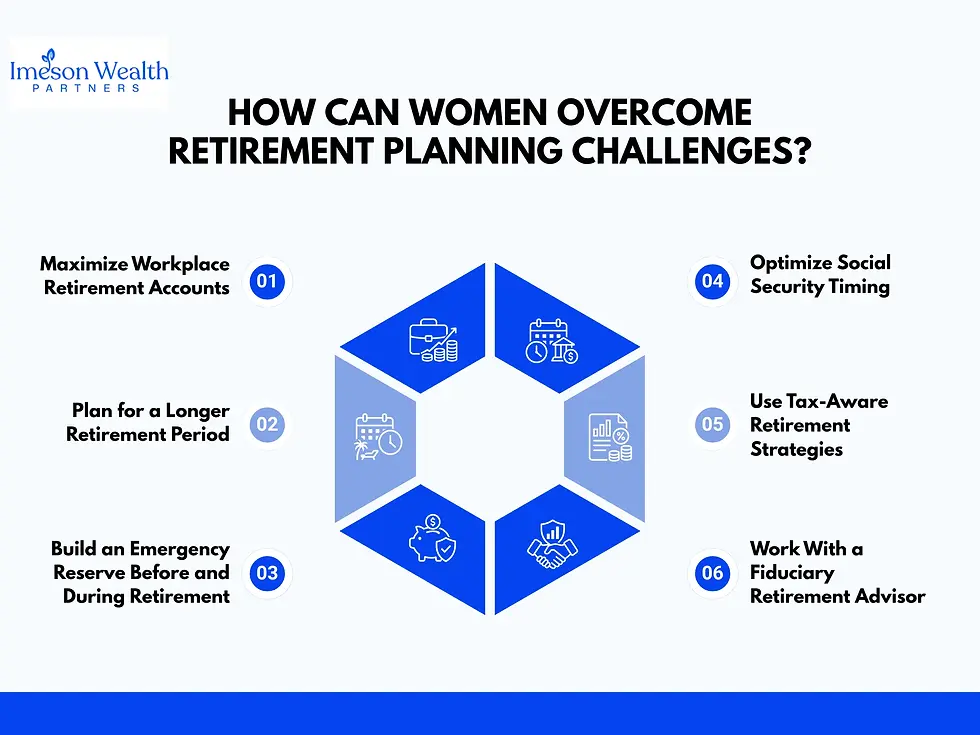
How Can Women Overcome Retirement Planning Challenges?
Women can overcome retirement planning challenges by increasing workplace contributions, planning for a longer retirement, building emergency reserves, timing Social Security carefully, using tax-aware strategies, and working with a fiduciary retirement advisor. These steps can strengthen savings, prepare for changing expenses, and coordinate retirement income effectively. Regular reviews help women adjust contributions, withdrawals, taxes, and benefit decisions as circumstances change.
Women can address these challenges through the following retirement planning steps:
Maximize Workplace Retirement Accounts
Contribute enough to receive the available employer match, then increase payroll contributions as income and cash flow allow. For 2026, employees can defer up to $24,500 to most 401(k), 403(b), and governmental 457(b) plans. Eligible workers age 50 and older may also use additional catch-up contribution limits.
Plan for a Longer Retirement Period
Estimate how many years retirement savings may need to provide income, then compare projected expenses with Social Security, pensions, and account balances. Women should account for housing, healthcare, inflation, taxes, and other recurring costs. Revisit these projections as retirement age, savings levels, life circumstances, and expected spending change.
Build an Emergency Reserve Before and During Retirement
Keep money available for unplanned expenses such as medical bills, home repairs, or temporary income disruptions. An emergency reserve can reduce reliance on credit or unplanned retirement-account withdrawals when unexpected costs occur. Set the amount according to regular expenses, income stability, available savings, and the types of financial disruptions you may face.
Optimize Social Security Timing
Compare Social Security estimates at different claiming ages before deciding when to start benefits. Retirement benefits can generally start at 62, while delaying beyond full retirement age increases the monthly benefit through delayed retirement credits until age 70. Coordinate claiming decisions with employment income, pensions, retirement withdrawals, healthcare needs, and expected spending.
Use Tax-Aware Retirement Strategies
Review how Traditional, Roth, and taxable accounts affect current and future taxes before deciding where to contribute or withdraw. Traditional retirement distributions are generally taxable unless you previously paid tax on the contributions, while qualified Roth distributions can be tax-free. Required minimum distributions also apply to certain accounts, making withdrawal timing an important part of retirement income planning.
Work With a Fiduciary Retirement Advisor
A fiduciary retirement advisor can help women evaluate retirement income, investments, taxes, Social Security, withdrawal decisions, and changing financial circumstances within one coordinated plan. When selecting an investment adviser, review registration, services, fees, and potential conflicts. Registered investment advisers are subject to fiduciary duties, including duties of care and loyalty toward clients.


Comments